
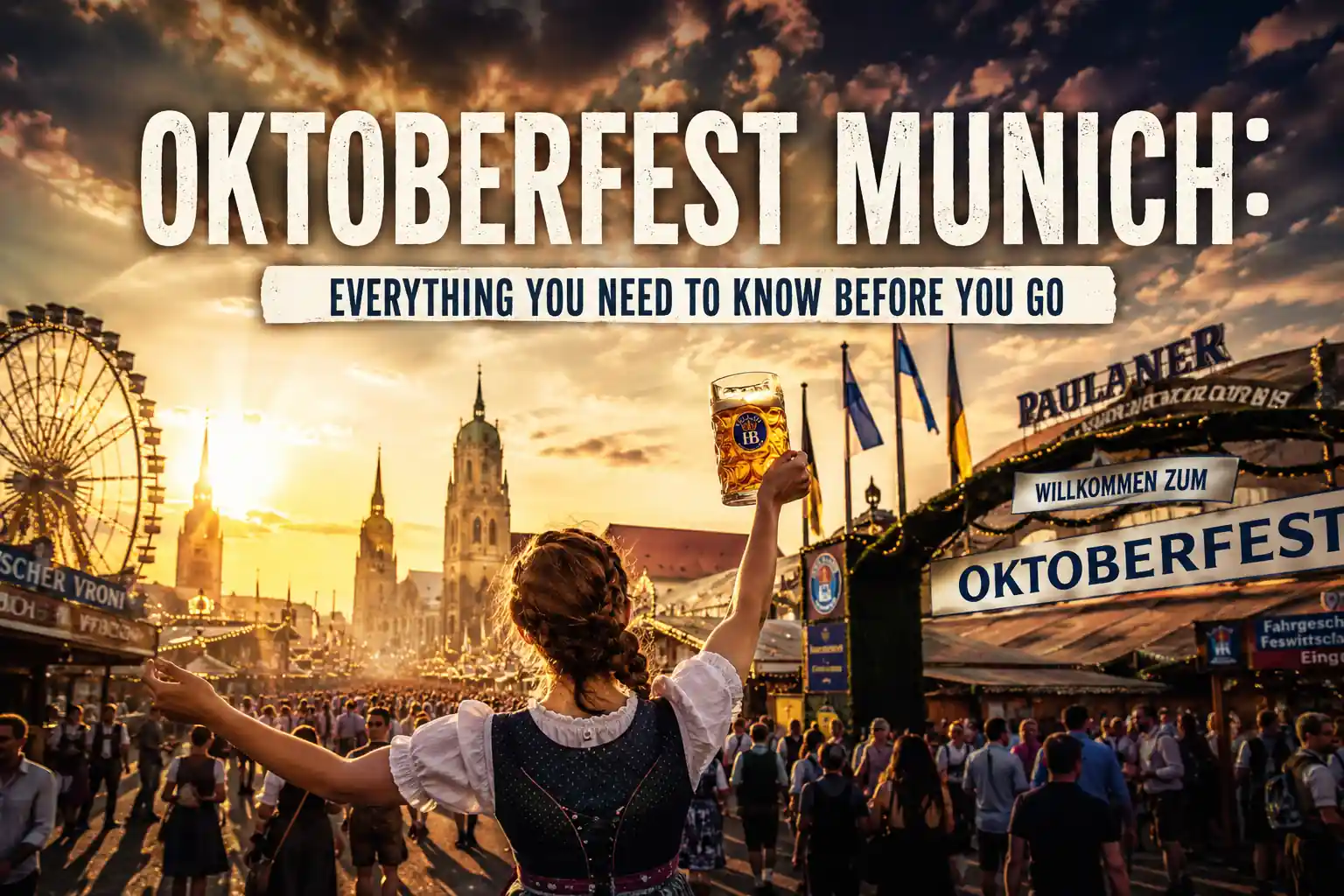
Oktoberfest Munich: Everything You Need to Know Before You Go
It is the world’s ultimate celebration of beer, community, and centuries-old tradition. Every autumn, millions of travelers from every corner of the globe gather on a vast meadow in Munich, Germany, to raise a massive glass of golden lager.
While the festival is famous for its high-energy atmosphere, navigating the massive crowds, secure tent bookings, and complex transport systems requires a clear strategy. This comprehensive guide gives you the exact blueprint you need to survive and thrive at the world’s largest Volksfest (peoples’ festival).
What Is Oktoberfest Munich?
Oktoberfest is a deep-rooted Bavarian tradition that began in 1810 to celebrate the royal wedding of Crown Prince Ludwig and Princess Therese of Saxe-Hildburghausen. The citizens of Munich were invited to join the festivities on the fields in front of the city gates—a space named Theresienwiese (Therese’s Meadow) in honor of the princess.
Why Is Oktoberfest the World’s Largest Beer Festival?
What started as a simple horse race has evolved into a massive 16-to-18-day cultural phenomenon. Today, the festival spans over 100 acres and attracts roughly 6 million visitors annually, who collectively consume more than 7 million liters of traditional Bavarian beer. It is an unrivaled celebration of Gemütlichkeit—a unique German word describing a deep feeling of warmth, friendliness, and good cheer.
Oktoberfest Dates & Location
The festival takes place at its historic birthplace: Theresienwiese in the heart of Munich, Germany.
To make the most of the warmer, longer autumn nights, the festival kicks off in mid-September and runs through the first weekend of October. It begins with the traditional mayor shouting “O’zapft is!” (It’s tapped!) to open the very first beer barrel.
Best Time to Visit: Days to Avoid Huge Crowds
If you want to avoid dense walls of crowds, timing your daily arrival is everything.
- Peak Congestion (High Stress): Opening weekend, closing weekend, and every Friday night or Saturday afternoon. During these windows, tents hit maximum capacity rapidly, locking their doors to non-reservation lines early in the day.
- Best Time to Visit (Relaxed & Atmospheric): Weekdays (Monday through Thursday) between 11:00 and 15:00. During these daytime hours, the grounds are spacious, lines are minimal, and finding an open seat at an unreserved table is much easier.
Best Beer Tents at Oktoberfest Munich
Oktoberfest features 17 large festival halls and 21 smaller specialized tents. Each tent pours exclusive brews from Munich’s historic “Big Six” breweries: Augustiner, Paulaner, Hacker-Pschorr, Löwenbräu, Hofbräu, and Spaten.
+------------------------------------------------------------------------+
|                      OKTOBERFEST LARGE TENTS VIEW                      |
+------------------------------------------------------------------------+
| [Schottenhamel] --> Historic Heart: Mayor taps the first barrel here   |
| [Hofbräu-Festzelt] --> High Energy: International hub & party crowds   |
| [Augustiner-Festhalle] --> Local Gem: Pours from traditional wooden kegs |
| [Hacker-Festzelt] --> "Bavarian Heaven": Stunning blue-sky ceiling      |
+------------------------------------------------------------------------+
Which Beer Tents Are Best for Tourists?
- For the Classic International Party: Hofbräu-Festzelt. With room for nearly 10,000 visitors, this tent is the most popular destination for international travelers. It features high-energy brass bands playing global party anthems and a lively standing-only zone.
- For Authentic Local Culture: Augustiner-Festhalle. This is widely considered the friendliest tent by locals because it is the only hall that still dispenses its beer from classic wooden barrels (Hirschen) rather than massive steel tanks.
- For Celebrities & Glamour: Käfer Wiesn-Schänke. A smaller, upscale log-cabin style tent famous for its gourmet food, late-night hours, and frequent sightings of international athletes and stars.
Traditional Bavarian Food You Must Try
Do not drink on an empty stomach. The festival beer is exceptionally strong, and eating hearty, rich food is vital to pacing yourself throughout the day.
- Wiesn-Hendl (Roasted Chicken): The definitive festival meal. Half a crispy, golden-brown chicken basted in butter and fresh parsley.
- Schweinshaxe (Roasted Pork Knuckle): A massive, tender pork joint roasted until the outer skin turns into a perfectly crunchy crackling. It is usually served alongside a rich dark beer sauce and Kartoffelknödel (potato dumplings).
- Brezn (Giant Pretzels): Oversized, freshly baked, and coated in coarse salt—ideal for soaking up alcohol between toasts.
- Steckerlfisch (Fish on a Stick): A classic treat consisting of skewered fish (usually trout or mackerel) grilled slowly over open charcoal fires.
Traditional German Outfits Explained
While you are not legally required to wear traditional clothing (Trachten), more than 80% of festival-goers do. Wearing authentic attire is a fantastic way to immerse yourself in the culture.
- For Men (Lederhosen): Durable leather shorts featuring H-shaped suspenders, paired with a checkered or solid white linen button-down shirt, heavy woolen socks, and traditional Haferlschuhe (leather outdoor shoes).
- For Women (Dirndl): A beautiful three-piece dress including a close-fitting bodice, a low-cut white blouse, and a high-waisted skirt with an apron tied over it.
🎀 The Secret Apron Bow Code: Pay close attention to how the apron string bow is tied, as it signals a woman’s relationship status:
- Tied on the Left: Single and open to conversation.
- Tied on the Right: Married, engaged, or in a committed relationship.
- Tied in the Center: Historically signals a virgin (today, often worn by children or those preferring privacy).
- Tied in the Back: Widowed, or a festival waitress hard at work.
How to Reserve Oktoberfest Munich Beer Tent Seats
Let’s clear up a massive misconception: entry to the Oktoberfest Munich grounds and every single beer tent is 100% free. You do not need a ticket simply to walk inside.
Can You Visit Oktoberfest Without Reservations?
Yes, absolutely. By strict city law, large percentages of tables in every major tent must remain unreserved and available on a first-come, first-served basis. If you arrive early on weekdays, you can simply walk into a tent and slide onto an open wooden bench.
The Booking Process
If you are traveling in a large group (usually 8 to 10 people) and want guaranteed seats during busy evening sessions, you must secure a formal reservation.
- No Centralized Booking: Reservations are managed individually by each tent’s private management office, not by the city of Munich.
- Timing: Portals generally open between January and April. You must apply directly on the specific tent’s official website.
- The Cost: The reservation itself is completely free, but you are required to pre-purchase vouchers (Marken) for food and drinks. A typical reservation requires purchasing two beers and half a chicken per person, totaling roughly €45 to €60 per seat.
How Much Does Oktoberfest Munich Cost?
Attending the festival can be expensive if you do not budget carefully. Here is an honest breakdown of standard costs on the grounds:
Expected Festival Prices
- Oktoberfest Munich Beer Prices: A single Maß (one liter of beer) generally costs between €14.00 and €16.00, depending on the tent.
- Tipping: It is customary to round up your total or leave a small cash tip (around €1 to €2 per drink) directly with your table waitress to ensure fast service during busy shifts.
- Food Costs: A half roasted chicken costs around €15 to €19, a giant pretzel costs €7 to €9, and hearty sit-down entrees range from €22 to €35.
- Cash is King: While credit cards are increasingly accepted across the grounds, many individual bars and traditional waitresses still accept cash only. Always carry physical Euros to avoid long ATM lines.
Best Hotels Near Oktoberfest Munich
Because millions of people visit the city during these weeks, hotel rates in Munich soar to peak luxury prices. Book your accommodations at least 6 to 9 months in advance.
- Ludwigsvorstadt & Schwanthalerhöhe: These neighborhoods border the Theresienwiese directly. Staying here allows you to walk to and from the tents without waiting for public transport. Expect premium, high-season rates.
- Altstadt (Old Town): Ideal for travelers who want to balance the beer halls with classic Munich sightseeing. It’s safe, beautiful, and connected to the grounds via a quick 5-minute subway ride.
- Pasing or Munich Airport Outskirts: If you are on a strict budget, find a hotel near an S-Bahn (suburban train) station outside the city center. You’ll save hundreds of Euros per night while enjoying clean, direct train access straight into the festival.
Oktoberfest Munich Travel Tips & Public Transport Guide
Navigating Munich during its busiest season is straightforward thanks to its highly efficient public transit infrastructure.
Getting to the Grounds
Do not even think about taking a taxi or driving a car to the festival; roads are completely blocked and parking is nonexistent. Instead, rely on the transit grid:
- Via U-Bahn (Subway): Take lines U4 or U5 directly to the Theresienwiese station. Alternatively, take lines U3 or U6 to Goetheplatz and follow the crowds walking to the eastern gates.
- Via S-Bahn (Suburban Trains): Take any main line train to Hackerbrücke. From there, join the thousands of festival-goers making the scenic 10-minute walk down to the festival grounds.
Family-Friendly Activities at Oktoberfest Munich
While the beer tents capture the global headlines, Oktoberfest is fundamentally a family-focused state fair. The fairgrounds are filled with massive amusement park rides, including the iconic Ferris Wheel, the high-speed Olympia Looping five-ring roller coaster, and traditional carnival games.
Every Tuesday is official Family Day, offering significant discounts on all carnival rides, performances, and food stalls from 10:00 until 19:00.
Oktoberfest Munich Rules & Safety Tips
Munich is incredibly safe, and the festival grounds are heavily monitored by local police and security personnel. However, following these basic safety rules will protect you from unnecessary headaches:
- Strict Bag Policy: Large backpacks, suitcases, and bags with a capacity greater than 3 liters are strictly banned from entering the grounds. Leave your large bags at your hotel or use the secure luggage lockers located at the main train station.
- Do Not Steal Glass Mugs: Attempting to take a heavy glass Maß mug out of a tent as a souvenir is a criminal offense. Security teams at the exits check bags thoroughly, and fines for theft are steep. If you want a mug, you can buy official, stamped souvenir versions at the vendor stalls outside the tents.
- The “Beer Corpse” Hill: The grassy slopes behind the tents are locally known as Kotzhügel (puke hill). Avoid resting here; it is where over-intoxicated visitors pass out and is a frequent target for pickpockets.
Common Mistakes First-Time Visitors Make
- Mistake 1: Standing on Tables Incorrectly. You are fully encouraged to stand up on the heavy wooden benches to cheer, sing, and toast. However, standing or dancing on the tables themselves is strictly prohibited and will result in immediate eviction from the tent by security.
- Mistake 2: Forgetting to Tip Your Waitress Early. Your waitress controls how fast your table gets drinks. Leaving a generous tip on your very first round ensures she returns to check on your group regularly throughout the busy evening shift.
- Mistake 3: Chugging an Entire Liter on a Dare. If you stand up on a bench and hold your glass high, thousands of people will cheer for you to chug the entire liter. Be warned: if you fail or take too long, the crowd will boo you—and regardless of whether you finish it, security will immediately escort you out of the tent for unsafe drinking. Pacing yourself is the real key to enjoying the magic of Oktoberfest.